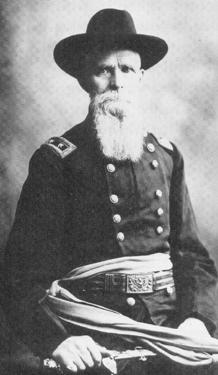
Burton, Robert Taylor, second counselor to Bishop Edward Hunter from 1875 to 1883, and first counselor to Bishop Wm. B. Preston since 1884, is the son of Samuel Burton and Hannah Shipley, and was born Oct. 25, 1821, at Amersberg, Canada West. He was the tenth in a family of fourteen children, seven of whom were born in England and the rest in America. His parents emigrated to America in 1817, and after residing two or three years in New York State they removed to western Canada.
Some time in the autumn of 1837 two "Mormon" missionaries came into the neighborhood where the Burton family resided. Robert T. Burton, then only sixteen years of age, persuaded his father to entertain the Elders and provide a place in which they could expound their views. Soon after this the youth visited some relatives in the State of Ohio, spending the winter at school and the next summer in helping his widowed sister, Mrs. Jane Layborne, upon her farm. During his absence from home his father's family was converted to "Mormonism." He was informed of this fact by his mother, who in September visited him and her kindred in Ohio, and requested him to accompany them in their proposed migration to the far west. This meant at that time the State of Missouri, where the Latter-day Saints were gathering in large numbers. He consented to do so, though not without some reluctance, the result of certain rumors unfavorable to the Saints that were afloat concerning them in Ohio.
Returning to Canada he was himself converted to the faith which his parents had espoused, and was baptized by Elder Henry Cook, October 23, 1838. In the latter part of that month he left Canada, with his father's family, for Far West, Caldwell county, Missouri, and had gone as far as Walnut Grove, Knox county, Illinois, when he learned of the terrible persecutions of the Saints in the adjoining State. He therefore concluded, with others, to remain at Walnut Grove, where a branch of the Church was organized, and there the Burton family resided for about two years. They then removed to Nauvoo. From June, 1843, to 1844, Robert T. Burton, who had been ordained an Elder, was absent from Nauvoo on a mission in Illinois, Michigan and Ohio, in company with Elder Nathaniel V. Jones. Having baptized a goodly number and organized branches in the two latter States, they returned home, Elder Burton's arrival being just two weeks before the martyrdom of the Prophet and Patriarch.
Right at this time he performed his first military duty, enlisting in Captain Gleason's cavalry company, Nauvoo Legion. He was on guard duty in Nauvoo at the time of the Carthage jail tragedy and for some time afterwards was constantly on duty there and in the vicinity, endeavoring to protect the lives and property of his persecuted people from rapine and robbery. A lover of music and possessing talent in that line, he became a member of the Nauvoo Brass Band, and also connected himself with the Nauvoo Choir, besides performing other public duties. In January, 1845, he was called on a special mission, with Elder Samuel W. Richards, to travel through some of the central counties of Illinois for the purpose of allaying prejudice in the minds of the people, the result of falsehoods circulated by apostates and others in the vicinity of Nauvoo. He returned in time to be married on the 18th of December, to Miss Maria S. Haven, the ceremony uniting the young couple being performed by President Brigham Young at the home of the Havens in Nauvoo.
The nearest approach to a wedding tour experienced by Bro. and Sister Burton was the tragic exodus of the ensuing spring, when the Saints began to leave Nauvoo upon their long and toilsome pilgrimage into the unknown West. The Burtons were in one of the first companies that started, crossing the Mississippi on the ice, February 11, 1846, and encamping on the western bank. The snow was about eighteen inches deep and the weather intensely cold—so cold that many of the homeless pilgrims were compelled to cross and recross the frozen river several times, with teams and wagons, for additional supplies of clothing, bedding and provisions. The Burtons left Sugar Creek in the general move westward. Progress was slow and difficult, owing to the absence of roads and the prevailing wet weather, the country being covered with water and mud almost the entire distance to the Missouri river, where they arrived about the middle of June.
The main camp was at Council Bluffs, but Bro. Burton with his wife and his aged parents made a temporary home at a point lower down the river. There his mother died, a victim to the hardships and exposures of the enforced exodus, and was buried in a lonely grave on the banks of the Missouri. The survivors of the family, after accumulating the necessary teams and supplies for the journey across the plains, left their Missouri home, and on May 20, 1848, rejoined the main body of the Saints at Winter Quarters. By this time the Pioneers had been to the Rocky Mountains and returned, and President Young and his associates were now organizing the main emigration. Robert T. Burton and his family were in the company led by Pres. Brigham Young, with whom they came to Salt Lake valley, arriving there in the latter part of September. During the journey Bro. Burton acted as bugler for the camp. He and his family lived in the Old Fort until January, 1849, when, Salt Lake City having been laid out and divided into ecclesiastical Wards, they moved into the Fifteenth Ward. Elder Burton first lived with his brother-in-law, William Coray, but on the 15th of August removed to the corner of Second West and First South streets, where he still resides. In the fall of that year the local militia was organized, under the reminiscent title of "Nauvoo Legion."
In the first company of cavalry that was formed—the one commanded by Captain George D. Grant—Robert T. Burton was appointed bugler. Early in 1850 this company was called into active service to defend the settlers in Utah county against hostile Indians. Leaving Salt Lake City on the evening of February 7th, they traveled all night, and arriving at Provo early on the morning of the 8th, found the Indians strongly fortified on the south bank of Provo river, where they stoutly defended themselves for three days against the attack of Captain Grant's "Minute Men" and others of the militia. On the third day a little company of cavalry made a determined assault upon the enemy's position, and after receiving the Indian fire, which momentarily checked their charge, rallied, swept on and captured a barricade formed by a double log house, from which the savages fled precipitately after defending it as long as possible. In the very thick of the fray, two of the cavalry men—Robert T. Burton and Lot Smith—heedless of the bullets that whistled past their ears and splintered the wood-work in every direction, rode round to the front of the house and spurred their horses into the passage way between the log buildings. They were the first of the troopers inside the house, most of their comrades entering by sawing through the logs at the rear.
The campaign was quite successful, the Indians being driven from the valley into the mountains. In September of the same year Elder Burton was one of a company ordered north against the Shoshone Indians, and in November he and his comrades again went to Utah county against a remnant of the tribe they had fought there the previous spring. While on this campaign he was elected lieutenant. In December he was ordered to Tooele county in pursuit of marauding savages. This trip was a very trying one, the company having no tents or other shelter, and being without sufficient bedding or clothing. After a hard experience they returned to Salt Lake City, having accomplished very little.
In June, 1851, he accompanied another expedition against the Indians on the western desert, and though the men suffered much for want of water, they were entirely successful, killing, in a battle fought at the edge of the desert west of Skull valley, nearly all the members of this hostile tribe. In the spring of 1852 he took a small company of men to Green river to serve papers issued from the District court and protect the settlers in that section from Indians and renegade white men.
The following year he was elected captain of company "A"—the original cavalry corps—and on March 1st, 1855, he received his commission as major. His commission as colonel came on June 12th, two years later.
In October, 1856, he accompanied the relief corps that went out to meet and help in the belated handcart companies, struggling through the snow five or six hundred miles east of Salt Lake City. The weather was extremely cold, and not only the immigrants but their rescuers ran short of provisions and were reduced to one-fourth rations, until the arrival of further relief. After the companies had been provided for as well as possible under the circumstances, Major Burton was placed in charge of the train and conducted it to Salt Lake City, arriving there on the last day of November. "This," says he, "was the hardest trip of my life. Many of the immigrants died from cold and hunger and were buried by the wayside." The next fall found him in the midst of the trouble known as the "Echo Canyon War."
On the 15th of August, pursuant to orders previously issued, he started eastward at the head of a small company of mounted men, numbering about eighty in all, to assist the immigration then en route to the Valley, take observations as to the movements of the United States troops also on the way to Utah, and report the information to headquarters. He faithfully carried out his instructions. Meeting, at Devil's Gate, on the 21st of September, the vanguard of Johnston's army, commanded by Colonel Alexander, Colonel Burton and his scouts hovered in the vicinity of the advancing troops, watching and reporting their movements until they arrived on Ham's Fork, twenty miles northeast of Fort Bridger. At the latter point, Colonel Burton joined General Wells, the commander of the Legion, now opposing, by order of Governor Brigham Young, the further advance of the invading army.
About the middle of October Colonel Burton, with a heavy force of cavalry, intercepted Colonel Alexander, who, finding his way through Echo Canyon blocked by ice, snow and hostile militia, was supposed to be attempting a detour to the northward, thinking to enter Salt Lake valley by the Fort Hall route. Alexander was compelled to return southward and camp on Black's Fork, where he was joined in November by General Johnston. The Federal army having gone into winter quarters at Fort Bridger, Colonel Burton rejoined General Wells in Echo Canyon. He remained there until the 5th of December, and then returned to Salt Lake City.
In the spring of 1858, when the people in general moved south to avoid a possible collision with the government troops, who were making preparations to march through Salt Lake City, Colonel Burton was left with a force of militia to guard the property of the absent community. In 1862, by order of Acting-Governor Fuller, he proceeded with a company of picked men as far east as the Platte river, for the purpose of protecting the mails from Indians and lawless white men, who, taking advantage of the outbreak of the Civil War, were attacking and burning mail stations, driving off stock, way-laying stage coaches, killing passengers, cutting open mail sacks and scattering the contents, and committing various other depredations. This duty he performed to the entire satisfaction of the governor and other authorities. In June of the same year occurred the "Morrisite War," in which Colonel Burton played a very prominent part, commanding, as deputy of the Territorial marshal, the posse sent against the Morrisites by order of Chief Justice Kinney of the Third District Court, whose writs the Morrisite leaders had treated with contempt, and with their followers were in armed rebellion against the execution of the laws. The details of this affair, including General Burton's trial on a trumped-up charge of murder—a vexatious proceeding instituted many years afterwards—with his triumphant acquittal (March 7th, 1879) by a jury composed equally of "Mormons" and non"Mormons," are related in Volumes two and three of Whitney's History of Utah. Robert T. Burton received his commission as major-general from Governor Durkee in 1868.
In all the military history of Utah up to the disbandment of the Nauvoo Legion in 1870, General Burton, under Lieutenant-General Wells, was one of the principal men in perfecting the organization and directing the operations of the Territorial militia. In addition to his military offices, he has held civic positions as follows: Constable of Salt Lake City in 1852; U. S. Deputy marshal in 1853 and for many years thereafter; sheriff, assessor and collector of Salt Lake county from 1854 to 1874; deputy Territorial marshal from 1861 until several years later; collector of internal revenue for the District of Utah, by appointment of President Lincoln, from 1862 to 1869; assessor of Salt Lake county in 1880; a member of the Salt Lake City Council from 1856 to 1873; and a member of the Legislative Council from 1855 to 1887.
While serving in the legislature, he was appointed in 1876 one of the committee of three to arrange, compile and publish all the laws of the Territory of Utah then in force, his associates in this important labor being Hon. Abraham O. Smoot and Hon. Silas S. Smith. From 1880 to 1884 Hon. Robert T. Burton was a member of the Board of Regents of the University of Deseret. His ecclesiastical record since coming to Utah is as follows:
In 1859 he was appointed counselor to Bishop Andrew Cunningham of the Fifteenth Ward, and in 1867 he became the Bishop of that Ward. In November, 1869, he went upon a mission to the Eastern States, and during his absence spent some time in the city of Washington, assisting Utah's delegate, Hon. William H. Hooper, in the interests of his constituency. In May, 1873, he left for Europe, to fill a mission placed upon him at the previous April conference. He visited various parts of Great Britain and the neighboring continent, spending some time in the principal cities of Germany, Austria, Italy, France and Switzerland. On returning to England he was appointed president of the London conference. July, 1875, found him again in Utah.
While in England in 1875 he was chosen second counselor to Edward Hunter, the presiding Bishop of the Church, but continued to act as Bishop of the Fifteenth Ward until 1877. After the death of Bishop Hunter, he became First Counselor to his successor, Bishop William B. Preston. The date of this appointment was July 31, 1884. Since that time he has acted continuously in this capacity.
Bishop Burton was one of the first of our citizens to engage in home manufacturing. Associated with A. O. Smoot and John Sharp, he built the Wasatch Woollen Mills on Parley's Canyon creek, near the southeastern part of Salt Lake City. He has a fine farm on State street, below the southern suburbs and for many years has been engaged in farming and stockraising. He has been thrice married and is the father of a numerous family of children, mostly sons. In his seventy-ninth year, Bishop Burton is still active in his labors, and may be seen daily at his post of duty in the presiding Bishop's office.—Orson F. Whitney.
Colonel Robert T. Burton of early American stock traveled extensively through the Eastern States, Central States, Europe and Southwestern Canada. June 11, 1844, found him in Illinois a few days before the martyrdom of the Prophet Joseph Smith and his brother Hyrum. He had become a member of the Church, and enlisted in Captain Gleason's Cavalry Company of the Nauvoo Legion. Early in life he became a military man. He possessed natural leadership. He was on guard duty in the City of Nauvoo at the time of the assassination of Joseph the Prophet, and for some time after; endeavering to protect the lives and property of the people from mob violence and robbery. He was bugler of the Nauvoo Brass Band.
Two years after his arrival in the valley, July, 1847, the organization of a territorial militia was commenced among which was the first company of cavalry, Captain George D. Grant, commanding, and Mr. Burton acting as bugler for the company. Early in the following year this company was called into active service by the governor to defend the settlers in Utah County against the hostile Indians. Leaving Great Salt Lake on the evening of February 7, 1850, they traveled all night, arriving at Provo early the following morning, where they found the Indians fortified on the south bank of the Provo River. The Indians stoutly defended their position for three days against the attack of the militia.
However, on the third day the little company of cavalry, commanded by Robert T. Burton, made a determined attack upon the Indians' fortified stronghold, but were momentarily checked by the fire of their opponents.
Burton's men quickly rallied, and charged upon the Indians from the one side, as Lot Smith brought up his men from the other side with such vigor, the Indians were routed from the protection of the cabin and fled to the mountains. He took part in many other Indian battles.
In the spring of 1852 Lieutenant Burton took a small company of men east to Green River to serve papers issued from the District Court and to protect the settlers from Indians and renegade white men. The following year he was made Captain of Company A. His Major's commission is dated March 1, 1855; his commission as Colonel is dated June 12, 1857; his commission as Major General, commanding the Salt Lake Military District, was given by Governor Durkee in 1868.
In October he went east with a company of picked men to rescue the handcart company who were in great distress some five or six hundred miles east of Salt Lake. The immigrants were stranded on the Pratt River. The weather was extremely cold, the snow deep, they ran short of provisions. This reduced the immigrants and their rescuers to one-fourth rations until an additional relief was sent from Salt Lake. After the immigrants were provided for as well as possible under the circumstances, Colonel Burton was placed in charge of the immigrant train, arriving at Salt Lake City the last day of November.
On the 15th of August, 1857, Colonel Burton was ordered to take a company of one hundred mounted men to assist the incoming immigrants and take observation of the movements of the approaching U. S. army, said to be coming for the purpose of exterminating the Mormons.
In 1862 he was ordered by Acting Governor Fuller to take a company of picked, courageous men and proceed as far east as the Platte River for the purpose of protecting the United States mail and telegraph route from the depredation of Indians and lawless white men, mail stations having been burned and stock driven off, mail sacks cut open and contents scattered. Thus he became a Civil War commander, keeping open an important line of communication on the North for President Abraham Lincoln. This duty he performed to the entire satisfaction of the Governor of the Territory and National Civil War authorities. The mail matter was collected and delivered to the Government Contractor on the Platte River.
"Burton as a man was entrusted with honorable and important positions in every walk of life. He was an outstanding figure among the people, in all the trying scenes passed through by them—plagues and poverty. And in all military efforts he ranked among the foremost.—Information from Utah and the Civil War.
Heart Throbs of the West, Kate B. Carter, Vol. 2, p. 404
The first company was called the "Deseret Musical and Dramatic Association," composed of members of the Nauvoo Brass Band, and a number of ladies and gentlemen whose inclinations were drawn irresistibly to the World of Make-Believe. Brigham Young heartily approved and became the chief patron. In the year 1850, the original Thespian group in the Rocky Mountains was organized. It is thought the group met at the old band wagon on the southwest corner of North Temple and First West Streets, and later at the home of William Clayton, where the permanent organization was effected. The personnel of the group, with some others, was as follows:
Hiram B. Clawson, Philip Margetts, James Ferguson, Robert Campbell, Edmund Ellsworth, Edward Martin, William Glover, William H. Kimball, Miss Margaret Judd, William Clayton, John Kay, R. T. Burton, Horace K. Whitney, Henry Margetts, George D. Grant, A. M. Musser, Miss Orum and Mary Badlam.
Heart Throbs of the West, Kate B. Carter, Vol. 4, p. 81