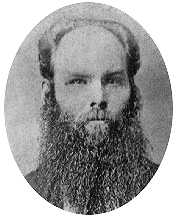
Lot Smith, born in Williams Township, Oswego County, New York, May 15, 1830, was the son of William O. Smith and Rhoda Hough. His father joined the Church of Jesus Christ of Latter-day Saints at an early date, then moved with his family to the headquarters of their church where they suffered the hardships and privations of its members. It was while the Saints were camped at Winter Quarters, now called Florence, Nebraska, that the call was made upon the Mormons for a company of 500 men. This was in the year 1846, the United States had declared war on Mexico. Lot Smith, although a boy of 16 years, volunteered and was mustered into the service of the United States with the memorable band of patriots known as the Mormon Battalion. It is said of him that he was so afraid that he would not measure up to the required height while passing the physical examination that he raised up on his toes. He was large for his age and was not questioned very closely by the recruiting officer about his age. The march of the Mormon Battalion from Leavenworth to California was one of hardship and suffering, all of which was borne by him without complaint.
One instance of the hardships of the Battalion boys is related: In crossing the desert the supply of water gave out and much suffering resulted, some of the men giving out completely and were left by the road side. The stronger of the men pushed on. For miles they were led by false mirages of the desert. Finally they came to a damp spot and dug down about eight feet and struck water. Among those sent back along the road with water for those who had fallen by the way was Lot Smith. He was given orders to give no man a drink until the furthest one back was reached. He passed a number of the first ones, obeying orders, but the pleadings of the men became so piteous that he could not resist giving them water. His supply held out until the last man was reached, and, although he had some left, for disobeying orders of his superiors he was punished. He was tied by his thumbs to the back of one of the wagons and compelled to walk for some distance under trying circumstances. This rather humiliated him, but he did not complain as he felt he had done an act of mercy and could not have done otherwise. This trait of his character was thus brought out early in his life, and was strongly developed in his later life, as those in need were never turned away. He, with others of the Mormon Battalion, was mustered out of the service in California in July 1847. After receiving his discharge, he, with a number of others, remained in California for some time working and doing some prospecting, as it was just about this time that gold was discovered in California at Sutter's Mill, the actual work that uncovered the gold, in digging the millrace being performed by members of the Mormon Battalion. He returned to Utah in 1849, bringing with him some gold dust. He told how one of the pack mules of the company, being so heavily laden while crossing a river, was drowned and his precious cargo was never found.
He took an active part in the affairs of Davis County, both secular and religious. He served one term as Sheriff of Davis [p.396] County in the '60s, and one term in the Territorial Legislature in 1871 or '72. His military experience was of great value to him and also to the community in the early days of Utah, and he was called often to go out to defend the people against the raids of the Indians; he was a natural leader of men. Lot was an officer of the old Deseret Militia and Major of the Utah Militia, and participated in nine different expeditions against the Indians besides taking an active part in other military movements. He was a great lover of horses, and whenever they came to a stop while out marching, his horse was always considered before anything else. He had his horses trained so that whenever he went against the Indians they would lie down with him in the brush and hide. This, on many occasions, saved him from capture.
Being the stamp of a man that he was, his services were constantly in demand during the first few years of the settlement of Utah. He paid considerable attention to the Indians, among whom he was first a source of terror, later an object of devotion, and almost invariably made them his friends. With his rough exterior he was thought by many to be a tyrant but such was not the case, and it seemed impossible for him to make complaint against those who presided over him, but with all his rough ways he had a heart within him that beat with human sympathy and an appeal to him for help was never made in vain. During practically the whole of his life he was on the frontier and was known as one of the minutemen.
He was called by President Brigham Young to take a most important part in the Echo Canyon Expedition in the year 1857 when the government troops headed for Utah for the purpose, as the Mormons thought, of exterminating them. In 1862 President Young, ex-Governor of Utah, was asked by President Lincoln, through Adjutant General L. Thomas, to raise, arm and equip a company of cavalry for the purpose of protecting the mail route against the Indians who at the time were very hostile, having destroyed mail stations between Fort Bridger and North Platte, and were attacking and robbing mail coaches and killing people. This call was quickly responded to and three days after the call came, Captain Lot Smith, with a company of 72 mounted men, took up the line of march for this purpose. It is said some of the men who were in that company came to Farmington each year on Decoration Day and held services over the grave of their dead Captain. From 1869 to 1871 he performed missionary work in the British Mission, laboring part of the time in Scotland.
In 1875 he was called again by President Young to head a company for the purpose of colonizing parts of Arizona. Previous attempts had been made by the Church to colonize Arizona but they had not met the President's expectations, and when this call was made President Young made the remarks, "I know Lot Smith will stay there until he dies if necessary." On February 1, 1875 he started for Arizona with about 200 persons, divided into four companies of 50 each with a man in charge of each company. Among them were quite a large number of Davis County people. They settled at a place called Sunset, and for a time lived the United Order, in which all members of the colony shared things in common. This colony after a time broke up and later a number of the colony settled at Moencopi where a different tribe of Navajo Indians was found—a people who knew no law and who had not been subdued by the government. When the Little Colorado Stake was organized Lot Smith was chosen as President and served in this capacity from 1877 to 1885 when the organization was abandoned. For a year or more he lived in Mexico at Diaz. When he returned from Mexico he settled at Tuba, Arizona, where he lived until his death at the hand of a renegade Navajo Indian.
The settlers had suffered considerably by the Indians allowing their sheep and cattle to trespass on the settlers' property. A certain wool buyer who was anxious to buy the Indians' wool had told them they had the right of the range for their stock and that the whites were driving them from their own lands. The Indians had let down the bars of the pasture belonging to Lot Smith and let in quite a number of sheep, and when he tried to drive them back out the sheep bunched, and Lot was unable to get them out. He went to the house and came back this time bringing his revolver. He tried again but failing became angry and drawing his revolver shot into the herd of sheep, killing six head. In a moment a half dozen Indians began shooting at his cows, killing five. Lot started home on horseback, and had just passed a point in the road where there was a large rock when an Indian fired from behind, striking him in the back, the bullet passing through his body in a slanting direction. He rode to the house, alighted from his horse, took off his revolver, went into his room without a word. When the family came into the room he exclaimed, "This is the last of me." His dying words were "God bless the wives and children."
Mr. Smith's body was buried in a lonely spot and the only marking of the grave was a small plum tree. It lay there for nearly ten years, but through the untiring efforts of some of his comrades, and the assistance of the Church authorities, his remains were exhumed and brought to Farmington, Utah, his old home. Memorial services were held at Farmington on the 8th of April 1902, the casket was draped with the American flag. The services were largely attended. President Joseph F. Smith, with other Church authorities, and a number of his old comrades of 1857 and 1862 spoke at the services, where eulogies were pronounced by them over the remains of their Captain. John R. Winder said, "I always admired Lot Smith for his bravery; his men loved and obeyed him for he was kind to them, and always in the lead." "I have this to say of my Commander," said James Sharp, "there lies a man who knew no fear. With his men he was gentle as a woman and as brave as a lion." President Smith said he was thankful that the remains of Captain Smith had been brought home where they might rest among his friends. "He was a generous, noble-hearted man," said President Smith, "and history will record the fact that Lot Smith was one of the notable figures of the past." In every instance he discharged his duty to the very best of his ability. After the services his remains were taken to the Farmington Cemetery, where a very substantial monument marks his last resting place.—Effie Smith Palmer
Our Pioneer Heritage, Vol. 15, p. 397